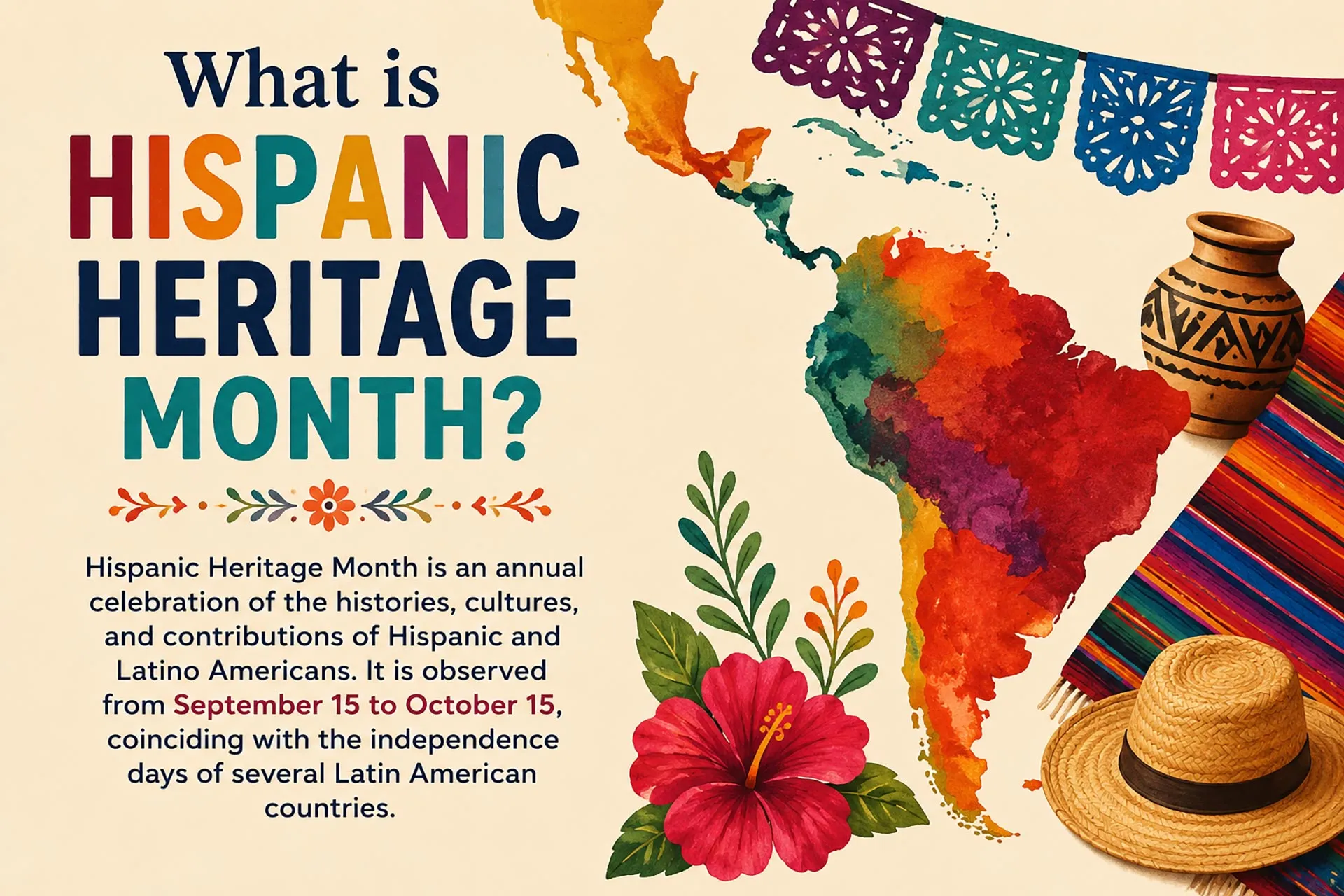
What is Hispanic Heritage Month?
Hispanic Heritage Month is a national celebration held every year from September 15 to October 15 in the United States. It recognizes the histories, cultures and contributions of Americans whose ancestors came from Spain, Mexico, the Caribbean, Central America and South America.
During this month, organizations across the country — from Fortune 500 corporations to universities to federal agencies — honor the generations of Hispanic and Latino Americans who have positively influenced and enriched our nation and society.
But Hispanic Heritage Month is more than a month on the calendar. It is a recognition that one in five Americans is Hispanic or Latino, and that the contributions of this community touch every aspect of American life — from the food we eat to the technology we use to the values that shape our workplaces. Needless to say, this is our busiest time of the year.
When is Hispanic Heritage Month?
Hispanic Heritage Month runs from September 15 through October 15 every year. Unlike most heritage months, it does not align with a single calendar month — and that is by design.
Why Does It Start on September 15?
September 15 was chosen because it is the anniversary of independence for five Central American nations that all declared independence from Spain on the same day in 1821:
- Costa Rica
- El Salvador
- Guatemala
- Honduras
- Nicaragua
These five nations signed the Act of Independence of Central America on September 15, 1821, making it one of the most significant dates in Latin American history.
Other Independence Days During the Period
Several additional countries celebrate their independence during the Hispanic Heritage Month window:
- Mexico — September 16 (independence from Spain, 1821)
- Chile — September 18 (independence from Spain, 1818)
- Belize — September 21 (independence from the United Kingdom, 1981)
The month also includes Dia de la Raza (October 12), celebrated across Latin America to commemorate the cultural heritage of indigenous peoples and the blending of cultures that occurred after 1492. Different countries observe this date under different names — Argentina calls it the “Day of Respect for Cultural Diversity,” Venezuela marks it as the “Day of Indigenous Resistance” and Spain observes it as “Dia de la Hispanidad.”
The History of Hispanic Heritage Month
Hispanic Heritage Week (1968)
The celebration began in 1968 when California Congressman George E. Brown introduced legislation authorizing the President to proclaim a week that included September 15 and 16 as “National Hispanic Heritage Week.”
President Lyndon B. Johnson signed it into law on September 17, 1968 (Public Law 90-498) and issued the first proclamation that same day. The resolution cited the many states, cities and towns with Hispanic names, the vital roles Hispanic people played in building American communities and the significant population of Americans bearing Spanish surnames.
Every president from Nixon through Reagan continued issuing annual proclamations for Hispanic Heritage Week.
Expansion to a Full Month (1988)
By the late 1980s, Hispanic leaders and lawmakers argued that a single week was not enough time to properly celebrate the contributions of the Hispanic community or organize meaningful programming.
Representative Esteban Torres of California was a key advocate for expansion, making the case that organizations needed more time to plan events, invite speakers and engage their communities. Senator Paul Simon of Illinois introduced the bill (S. 2200) in the Senate.
President Ronald Reagan signed the expansion into law on August 17, 1988 (P.L. 100-402). The following year, President George H.W. Bush issued the first Hispanic Heritage Month proclamation on September 14, 1989.
Every president since has continued the tradition of issuing an annual Hispanic Heritage Month proclamation. The 2025 theme was “Collective Heritage: Honoring the Past, Inspiring the Future.”
Why Do We Celebrate Hispanic Heritage Month?
Hispanic Heritage Month exists to recognize the extraordinary contributions of Hispanic and Latino Americans to our nation. Here is why this celebration matters:
The Hispanic Community by the Numbers
The U.S. Hispanic population has reached approximately 68 million people, representing 20% of the total U.S. population. For the first time in history, one in five Americans is Hispanic or Latino.
Key facts about the Hispanic community in the United States:
- Economic powerhouse: U.S. Latino GDP reached $4.1 trillion, making it the equivalent of the world’s fifth-largest economy — larger than India’s GDP
- Growth engine: Hispanics accounted for 56% of total U.S. population growth from 2000 to 2024
- Workforce drivers: Hispanic workers are projected to account for 78% of net-new workers between 2020 and 2030
- Entrepreneurial spirit: Hispanic/Latino-owned employer businesses increased by 44% between 2018 and 2022, and nearly one in four new U.S. entrepreneurs is Hispanic
- Educational progress: Hispanic adults with a bachelor’s degree or higher roughly doubled from 11.1% in 2002 to 20.9% in 2022
- Innovation leaders: Latino-owned businesses are adopting AI at twice the rate of white-owned businesses
- Young and growing: The median age of Hispanic Americans is 31.2 years, compared to 43.2 for White Americans — meaning this community will shape America’s future workforce for decades
Hispanic Heritage Month provides a dedicated time to acknowledge these contributions and the people behind them — from the scientists and inventors who changed the world to the entrepreneurs building the businesses of tomorrow.
Hispanic vs. Latino vs. Latinx: Understanding the Terms
One of the most common questions during Hispanic Heritage Month is about terminology. Here is a clear breakdown:
Hispanic
Based on language. Refers to people from Spanish-speaking countries, including Spain and Equatorial Guinea. Does not include Brazil (Portuguese-speaking), Belize (English-speaking) or Haiti (French/Creole-speaking). First used on the U.S. Census in 1970.
Latino / Latina
Based on geography. Refers to people from Latin America, including Brazil and Haiti, but excludes Spain. “Latino” is the masculine/default form; “Latina” is the feminine form.
Latinx
A gender-neutral alternative that emerged from U.S. academic and LGBTQIA+ communities in the mid-2000s. However, only 4% of Hispanic/Latino adults prefer this term according to a 2022 Gallup poll, and only 23% have heard of it.
Latine
A gender-neutral alternative that originated within Spanish-speaking countries. The “-e” ending is more easily pronounced in Spanish and can be pluralized (“Latines”). Generally better received than “Latinx” among native Spanish speakers.
What Do Most People Prefer?
According to 2022 Gallup polling: 57% said the choice between labels did not matter to them, 23% preferred “Hispanic,” 15% preferred “Latino/Latina” and 4% preferred “Latinx.”
The key takeaway: Hispanic Heritage Month uses “Hispanic” in its official name, but many people within the community identify differently. When in doubt, ask individuals how they prefer to identify.
Important: Hispanic Is Not a Race
One of the most common misconceptions is that Hispanic is a racial category. It is not — Hispanic is an ethnicity. Hispanic Americans identify across all racial categories: 65% white, 27% “some other race,” 5% mixed race, 2% Black, 1% indigenous and 0.4% Asian, according to U.S. Census data.
Common Myths About Hispanic Heritage Month
Myth: Hispanic Heritage Month Covers a Standard Calendar Month
It runs from September 15 to October 15, spanning parts of two calendar months.
Myth: Cinco de Mayo Is Mexican Independence Day
Cinco de Mayo (May 5) commemorates the 1862 Battle of Puebla. Mexico’s actual independence day is September 16 — which falls during Hispanic Heritage Month.
Myth: All Hispanics Share the Same Culture
The Hispanic community encompasses people from over 20 countries across multiple continents, with vast differences in culture, cuisine, traditions, racial identity and political views.
Myth: All Hispanics Speak Spanish
While Spanish is a common thread, many Hispanic Americans are English-dominant, bilingual or speak indigenous languages. Brazil, the largest country in Latin America, speaks Portuguese.
How Organizations Celebrate Hispanic Heritage Month
Corporate Celebrations
Fortune 500 companies increasingly use Hispanic Heritage Month to engage employees and demonstrate commitment to diversity and inclusion:
- Employee Resource Groups (ERGs): Companies like Google (HOLA), Microsoft (HOLA — Hispanic & Latinx Organization of Leaders in Action), Visa (Latinx Connect) and AbbVie (AHORA) run extensive programming including keynote speakers, panel discussions and cultural events
- Speaker series: Many organizations bring in Hispanic keynote speakers to deliver presentations on innovation, leadership, heritage and the intersection of culture and business
- Cultural events: Cooking classes, music performances, film screenings, art exhibitions and heritage food tastings
- Professional development: Workshops on leadership, mentorship programs and career advancement sessions focused on the Hispanic workforce
- Community engagement: Volunteering with Hispanic-serving organizations, partnerships with the U.S. Hispanic Chamber of Commerce and ESL teaching programs
University & Educational Events
- Keynote speakers for campus-wide celebrations and Hispanic Heritage Month convocations
- Partnerships with organizations like Latinas in Tech for student mentoring
- STEM outreach programs exposing students to Hispanic role models in science and technology
- Art exhibits showcasing Latino heritage
- Financial literacy and personal branding workshops
K-12 Schools
- Lessons on Hispanic inventors, scientists and historical figures
- Research projects on civil rights movements like the Delano Grape Strike
- Cultural food events and recipe collections
- Reading programs featuring Hispanic authors
- Activities highlighting Hispanic contributions to STEM, arts and society
Government Programs
The federal government provides extensive resources through:
- hispanicheritagemonth.gov — the official federal hub
- Smithsonian Institution — lesson plans, videos and virtual exhibits
- Library of Congress — images, exhibits, audio and video collections
- National Museum of the American Latino — curated teaching and learning resources
- Annual presidential proclamations setting themes for each year
Notable Hispanic Americans Who Shaped Our World
Hispanic Heritage Month is the perfect time to celebrate the individuals who have made extraordinary contributions across every field:
Science & Space: Dr. Ellen Ochoa (first Hispanic woman astronaut), Mario Molina (Nobel Prize, ozone layer discovery), Franklin Chang-Diaz (7 space shuttle missions), Diana Trujillo (Mars Perseverance mission lead)
Technology & Innovation: Luis von Ahn (CAPTCHA, Duolingo), Guillermo Gonzalez Camarena (color television), Luis E. Miramontes (birth control pill), Julio Palmaz (intravascular stent)
Arts & Entertainment: Rita Moreno (first Hispanic PEGOT winner), Lin-Manuel Miranda (Hamilton), Selena Quintanilla, Celia Cruz, Gustavo Dudamel (LA Philharmonic conductor)
Politics & Law: Sonia Sotomayor (first Hispanic Supreme Court Justice), Cesar Chavez and Dolores Huerta (United Farm Workers founders)
Business: The Unanue family (Goya Foods), Nina Vaca (Pinnacle Group CEO)
Want to dive deeper into the inventors? Read about Hispanic Inventors Who Changed the World.
How to Plan a Hispanic Heritage Month Event at Your Organization
Planning a successful Hispanic Heritage Month celebration takes preparation. Here are the key steps:
1. Start Planning Early (3-6 Months Ahead)
The most impactful events are planned well before September. Begin outreach for speakers, budgeting and programming by March or April at the latest.
2. Book a Keynote Speaker
A compelling keynote speaker sets the tone for your entire celebration. Look for speakers who can connect Hispanic heritage to your organization’s mission — whether that is innovation, leadership, diversity or technology.
Book Ariel Coro as your Hispanic Heritage Month speaker — a bilingual AI and technology keynote speaker who connects the legacy of Hispanic innovation with the AI-driven future. Trusted by 100+ organizations.
3. Engage Your ERGs and Employee Networks
Partner with Hispanic/Latino ERGs to co-plan events. Their insight ensures programming is authentic and resonant.
4. Mix Education with Celebration
Combine cultural celebrations (food, music, art) with educational programming (speaker series, panel discussions, workshops). The best events do both.
5. Make It Accessible
Offer virtual and in-person options. Consider bilingual programming. Record sessions for those who cannot attend live.
6. Extend Beyond the Month
The best organizations weave Hispanic heritage into year-round programming rather than confining it to 30 days.
Hispanic Heritage Month 2026: Key Dates
Mark your calendar for Hispanic Heritage Month 2026:
- September 15 — Hispanic Heritage Month begins; Independence Day for Costa Rica, El Salvador, Guatemala, Honduras and Nicaragua
- September 16 — Mexican Independence Day
- September 18 — Chilean Independence Day
- September 21 — Belizean Independence Day
- October 12 — Dia de la Raza / Day of Cultural Diversity
- October 15 — Hispanic Heritage Month ends
Bring Hispanic Heritage Month to Life at Your Event
Hispanic Heritage Month is an opportunity to educate, inspire and celebrate. Whether you are planning a corporate event, university convocation, ERG program or community celebration, a powerful keynote speaker can transform your event from a checkbox into a memorable experience.
Ariel Coro is a bilingual AI keynote speaker and technology expert who connects the incredible legacy of Hispanic inventors and innovators with the AI-powered future we are building together. His customizable keynotes are available in English and Spanish, in-person or virtual.
Book Ariel Coro for Your Hispanic Heritage Month Event
Contact Coro’s Team to Check Availability
Sources: Library of Congress, National Archives, U.S. Census Bureau, Smithsonian Institution, hispanicheritagemonth.gov, Gallup, 2024 LDC U.S. Latinos in Tech Report