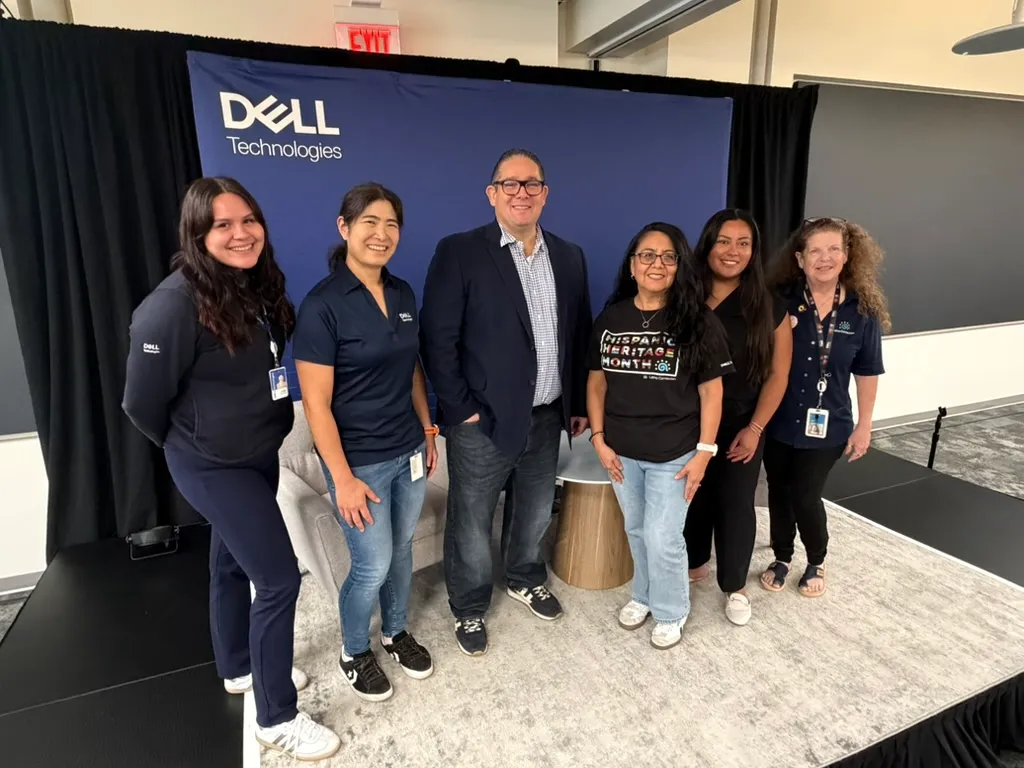
This past Thursday, I had the privilege of bringing my keynote, Innovating with an Accent, to Dell Technologies at its headquarters in Round Rock, Texas, as part of Hispanic Heritage Month.
One unexpected highlight was having Michael Dell pop into the session. It was a great surprise and made an already special day at Dell Technologies even more memorable.
The audience joined both in person and online, which made the session feel bigger than the room. We explored a question that matters to every organization facing rapid change: How do teams turn different perspectives into better ideas, stronger decisions and useful innovation?
For me, the answer begins with our “accent.”
Your accent is more than the way you speak
When I talk about having an accent, I am not only talking about pronunciation. Your accent includes where you grew up, the problems you have solved, the people who shaped you and the experiences that taught you to see the world differently.
That perspective matters at work. A team where everyone approaches a problem in the same way will often reach the same familiar answers. When people bring different experiences to the table, they challenge assumptions that otherwise go unnoticed.
That is why diversity is such a powerful driver of innovation. It gives a team more possible moves.
During the keynote, I defined innovation in a simple way: innovation is applying creativity to a problem. Creativity produces possibilities. Innovation turns one of those possibilities into something people can actually use.
Innovation is a team sport
Great ideas rarely arrive fully formed. They improve through conversation, disagreement, testing and revision. Different perspectives create useful tension. Trust keeps that tension productive.
Strong teams can challenge an idea without making the person who proposed it feel dismissed. They can test what works, admit what does not and use the result to make the next attempt better.
That process matters even more now that AI has entered the room.
One example I shared was centaur chess, where humans and computers play as partners. The machine can search an enormous number of possibilities at speed. The human frames the problem, weighs context and decides when to trust the output. The strongest advantage comes from the partnership and the process that guides it.
The same principle applies inside an organization. AI can help a team explore more options, but people still supply judgment, imagination and accountability. AI becomes more valuable when it amplifies human curiosity and creativity.
Better decisions require more than a good outcome
I also brought ideas from Annie Duke’s Thinking in Bets into the conversation. One of the most useful is the distinction between the quality of a decision and the outcome that follows it.
A thoughtful decision can produce a disappointing result. A careless decision can get lucky. When we judge the process only by what happened afterward, we lose the chance to learn.
The better question is: Was the decision sound based on what we knew at the time?
That question changes the quality of a team discussion. It encourages people to make their assumptions visible, talk honestly about uncertainty and review how they reached a conclusion. That kind of reflection helps teams improve instead of simply celebrating wins and assigning blame for losses.
Constraints can give innovation direction
We also discussed how limitations can sharpen an idea. A real constraint forces a choice. A carefully designed constraint can reveal a better path before a crisis makes that choice for you.
This does not mean that every obstacle is useful. It means that teams often become more inventive when they clearly understand the boundary they must work within. A budget, deadline or technical limit can eliminate options that will not work and focus attention on the ones that might.
Resourcefulness has always been part of my own story. Many of us learned to repair, repurpose and improvise because the ideal tool or unlimited budget was not available. Those experiences are not shortcomings. They are training in how to innovate.
The feedback that stayed with me
After the session, one of the organizers sent me a message that said:
“Everyone enjoyed today’s session. We have heard great feedback, and we had a lot of people joining online too.”
That meant a great deal to me. A keynote succeeds when people leave with a new way to think about the work in front of them and the confidence to contribute their own perspective.
Thank you to the Dell Technologies team for the invitation, the thoughtful conversation and the warm welcome in Round Rock.
The closing idea from the session is the one I hope the audience carries forward: continuous innovation is a team sport fueled by diversity, whether your teammates are human or AI and whether you have an accent or not.
Interested in bringing Innovating with an Accent to your organization? Let’s talk.