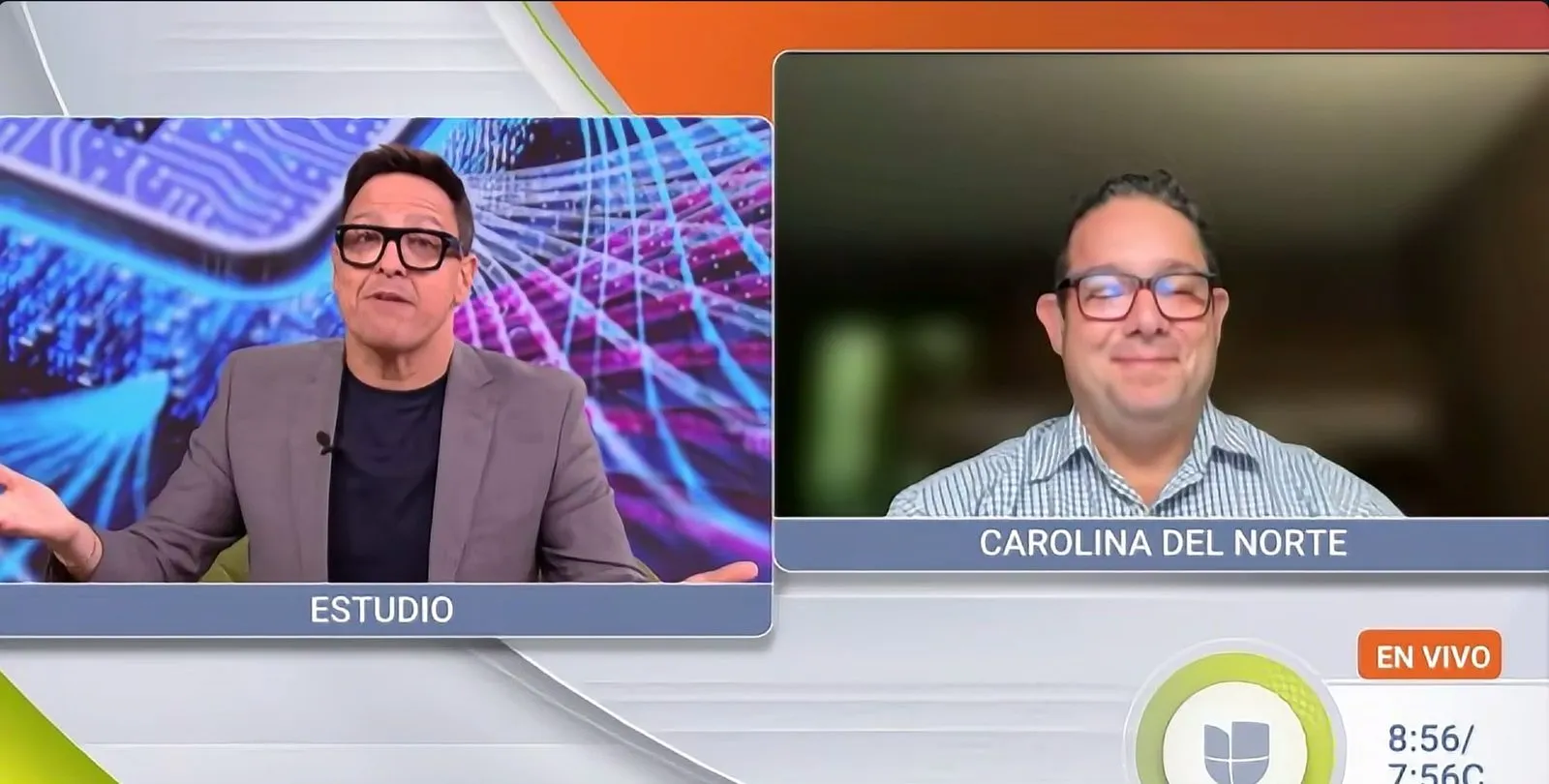
This morning I was back on Despierta América, and this time it wasn’t a quick tech hit. It was a debate. The host put the question on the table right away: artificial intelligence, does it mean we’re moving forward, or is it a threat?
Then he turned to me first, on Zoom from North Carolina, with three guests sitting in the studio ready to disagree with each other. That’s my kind of segment.
My answer: yes, but not the way the movies told you
Artificial intelligence can absolutely become a threat. Just not the one Hollywood sold us.
AI has no ambition. It has no intentions of its own. It isn’t sitting there resenting us. The danger is in who’s using it, what they’re using it for, and how much control we hand over to that person. That’s it. That’s the whole thing.
So when people ask me what the real threats are today, I don’t talk about robots. I talk about manipulation, cyberattacks, deepfakes, and decisions people make by blindly trusting a machine that gets things wrong too.
That last one is the one nobody takes seriously enough, and somebody on the panel had the perfect example.
The carwash question
Somebody asked an AI chatbot something like this: I need to take my car to the carwash, but my doctor told me I need to walk more. What if I drive the car to the carwash and then I walk?
And the AI told them that sounded great.
Read it twice. It makes no sense. You drove. But the machine agreed with you, confidently, because agreeing is what it does. That’s a silly example with no consequences. Now put that same behavior on a medical question, a legal question, or a decision about your money.
We’re the ones feeding these systems. They don’t know everything, and they’re built to sound sure of themselves either way.
The panel didn’t agree, and that was the best part
Paola uses it every single day. She’s named it, she calls it her partner, and she deliberately won’t assign it a gender because she doesn’t want to humanize it that much. Her argument was that it’s a tool that saves her time and makes her work sharper. She also said something I liked a lot: she doesn’t trust it a hundred percent, she checks its work, and she argues with it when it’s wrong.
Jennifer Jaime, who runs a company called Tales of Design, pushed back on the idea that AI is replacing creative people. Her point was that there’s always a human behind the script, the images, the characters. The machine only produces what you direct it to produce. No direction, no creativity.
And Alejandra Gómez, a journalist and a mother of three, brought up the part that should worry all of us. She isn’t against using it, she’s against abusing it. She talked about teenagers building relationships with chatbots, about people using AI in place of a therapist, and about cases that ended in tragedy. Then she said the line that stuck with me: consulting it constantly makes you stop thinking.
She and I don’t see eye to eye on everything. She thinks we’re closer to the science fiction scenario than I do. But on that specific point she’s right, and it’s the thing I keep coming back to.
The risk nobody wants to talk about
We’re getting comfortable letting AI think for us.
AI will help you write, research, analyze, plan. It will also be completely wrong and tell you so with total confidence. It’s like asking directions from somebody who has never set foot in the city but is too proud to admit it, so they point you somewhere with a straight face.
If we stop questioning the answers, stop checking where the information came from, stop using the judgment we spent a lifetime building, we handed over something that’s very hard to get back.
AI should expand our thinking, not replace it. That’s the whole idea behind Synaptic Innovation™, the keynote I give to companies about putting human creativity and AI to work together instead of handing over the wheel.
The same thing applies to your job. The host mentioned it on air: some people have lost work to this technology while others have built businesses and real income with it. Both things are true at the same time. Some tasks are going away, plenty of professions will look different in five years, and there’s real opportunity for the people who learn to put their experience and their judgment on top of these tools instead of competing with them.
Everybody wants to argue about how many jobs AI will eliminate. I’d rather ask the better question: what are we actually doing to get workers, students and companies ready to use it instead of getting run over by it? That’s the conversation I end up having with leadership teams in The AI Advantage: From Anxiety to Action.
Is there anything that can actually protect us?
They asked me directly whether any technology exists that can protect us, since Europe has regulation and most of the world doesn’t.
Yes, tools exist. None of them are infallible.
The AI content detectors out there will point you in a direction, but they get it wrong often enough that I wouldn’t treat any of them as a verdict. The more promising answer is content credentials, basically a digital seal attached to content that tells you where it came from and what touched it along the way. The open standard is called C2PA, and I describe it as a nutrition label for photos, audio and video. You finally get to see the ingredients.
The problem is that it hasn’t been adopted universally, so a file without a credential isn’t automatically fake. We’re not there yet.
Worth noting too: some of the models released recently have had to be pulled back after risks were detected. That should tell you something about how fast this is moving relative to how carefully it’s being tested.
The International AI Safety Report 2026, which more than a hundred experts worked on, makes a distinction I wish more people would make. There’s damage that’s already documented and sitting in front of us, and then there are future scenarios that are still uncertain but could get serious. Those are two different conversations and we keep mashing them into one.
Five things you can do today
While the rules and the standards catch up, these habits will protect you right now.
- Slow down the second a message is trying to scare you or rush you. Urgency is the oldest tool in the box.
- Go find the original post and see whether it shows up on an official account or an actual news outlet.
- Run a reverse image search on the photo. You’d be surprised how often it’s years old or from another country entirely.
- If a call feels wrong, hang up and call the person back on a number you already have. The FTC recommends exactly that against the voice cloning scams.
- Agree on a code word with your family for emergencies, and turn on multi factor authentication everywhere you can.
The bad guys live on urgency. Thirty seconds of pausing has saved a lot of people a lot of money.
And one more that came up on air: your face and your voice are being used too. People are putting all of us in situations that never happened and selling products we never endorsed. That’s where the law still has a lot of catching up to do.
The rules have to catch up
Europe is out in front with its AI Act, which sorts systems by how risky they are and puts transparency requirements on certain AI generated content and deepfakes. Some of those rules kick in in August 2026, according to the European Commission.
Other countries have pieces of it, a law here, an initiative there, but there’s no global system and there won’t be one anytime soon. Laws move slow. Technology doesn’t.
So we need more than one defense working at once: regulation, platforms taking responsibility, standards that prove where content came from, people who know how to spot this stuff, and an actual human still in the loop when it counts.
Where this really lands
I told them on air that we’re walking a tightrope. This is the super tool of the century and it can also do an enormous amount of damage, and both of those are true on the same day.
The host closed with an analogy I’m going to steal. He held up a pen. You can use it to write on a card, or you can use it to scratch up your furniture. Same pen. The difference is the person holding it.
I’m not interested in panic. I’m also not interested in applauding every new release like nothing could possibly go wrong. AI multiplies whatever you point it at, your best ideas or your worst impulses, and what we end up with depends on what we decide right now: what limits we set, who we hold responsible, and how much of our own judgment we’re willing to keep.
That’s the conversation I have with audiences as an AI keynote speaker, and it’s what I said this morning: use artificial intelligence to add to what you can do, never to give it away.
AI should expand our thinking, not replace it.