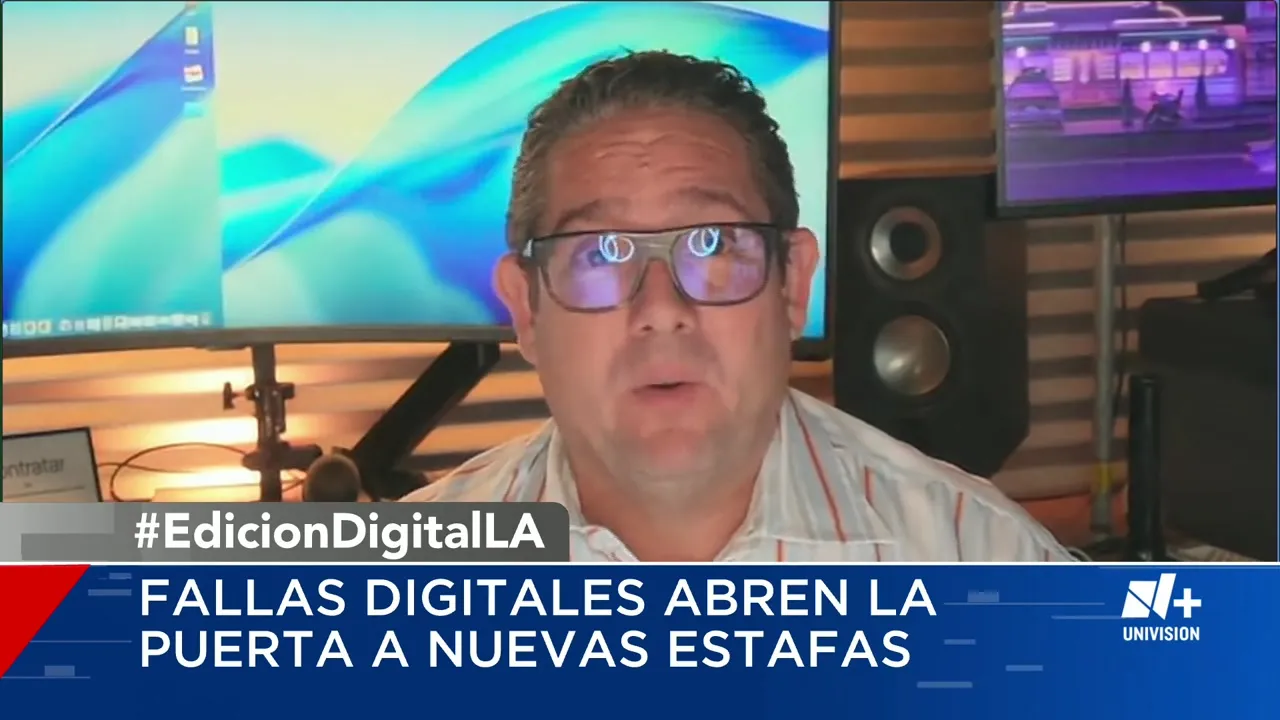
On Wednesday afternoon, November 18, 2026, I joined Yarel Ramos live on Univision 34 Los Ángeles’ Edición Digital LA. Her lead-in to the segment summed it up: after the failures at banks and digital services, be careful with anyone who offers to help you recover your account, because that person could be a scammer.
The interview ran in two parts. The first aired in the newscast under the headline “Estafadores aprovechan fallas digitales.” The second ran a few minutes later as a continuation on Univision’s digital platforms, under “Fallas digitales abren la puerta a nuevas estafas.” Both segments are in the video below (part two starts at 2:33), followed by the context and the practical steps.
A week of outages
The segment followed several days of high-profile service disruptions. None of them has been attributed to an attack.
- Microsoft 365 (November 12–13). Outlook, Teams and other Microsoft 365 services were unavailable or degraded for many users for more than a day. Microsoft said there was “no indication this is the result of malicious or cyber activity.” It attributed the incident to “an issue during an earlier network capacity upgrade that surfaced following a recent network change.”[2]
- JPMorgan Chase (November 16). Customers reported trouble reaching accounts and completing transactions. According to an FBI official cited by Fox Business, the disruption was traced to a software release Chase rolled out that morning, and there was no indication of malicious or external cyber activity. Chase said: “This is a technical issue, not cyber-related.” Other banks were affected only on transactions where Chase was a party.[3]
- Apple (November 17). iCloud sign-in, Apple retail store systems and other services went down. Apple told Bloomberg the outage was caused by an unspecified “internal update” and was not a cyberattack.[4]
A technical failure doesn’t put your money at risk by itself. The risk is what comes next, when millions of people are nervous, refreshing their apps and expecting messages from their bank or their tech provider.
How scammers exploit the confusion
Yarel’s first question was what kinds of scams show up after failures like these. My answer started with who is on the other end:
“Bueno, después de las fallas hay que darse cuenta que los bandidos escuchan las mismas noticias que nosotros, y las alertas generalmente tienen que ver con la noticia que acaba de pasar.”
“Well, after these failures you have to realize that the crooks listen to the same news we do, and the alerts usually have to do with the news that just happened.”[1]
On air, I gave two examples of what those messages sound like. One says the accounts went down and offers to send a verification code “to make sure everything is fine.” The other says your account was hacked and asks for the confirmation number you’re about to receive. Either way, the goal is the same:
“…lo que están tratando es de acceder nuestra información y nuestras cuentas utilizando la confusión y el pánico para confundirnos.”
“…what they’re trying to do is get into our information and our accounts, using confusion and panic to throw us off.”[1]
That pattern has already been documented during this round of outages. On November 13, Microsoft Threat Intelligence observed a “coordinated, high-volume phishing campaign” using emails disguised as Microsoft 365 service-health notifications. The emails claimed messages had been held during a service disruption and would be deleted within 24 hours, and pushed recipients to a “RESTORE MESSAGES” button. Microsoft assessed the activity as likely credential phishing, though it said the evidence did not confirm that credentials were captured. It also warned that threat actors “may continue to look for ways to exploit notable global events.”[5] After the Chase outage, LendingTree analyst Matt Schulz also warned customers to watch for scammers exploiting the confusion.[3]
The biggest red flag: urgency
Yarel pointed out that these messages often carry the bank’s logo, the customer’s name and some personal details, and asked how anyone can tell what’s real. The signal I told viewers to watch for:
“…la señal más importante… es que ellos siempre van a tratar de crear urgencia.”
“…the most important signal… is that they will always try to create urgency.”[1]
The person contacting you is the one who started the conversation, and they’re pushing you to hand something over right now. The response I recommended was simple: “colgar esa llamada y llamar a tu banco con el número que está en tu tarjeta de débito o de crédito” (“hang up that call and call your bank using the number on your debit or credit card”). The reason is that “hasta el mismo número que te sale cuando te están llamando puede ser falsificado” (“even the number that shows up when they call you can be faked”).[1]
The FTC makes the same point. Patty Hsue, chief of staff of the FTC’s Division of Marketing Practices, told CNBC that caller IDs and emails can be spoofed, and that consumers should contact the company independently rather than respond to the message. She also described a growing hybrid scheme: it starts with a “your account has been compromised” message, then hands the victim to a fake government agent who says to move their money to protect it.[6]
What never to share
When Yarel asked what information we should never share with someone who calls or texts, my answer was to never confirm any personal information and never share a verification code. Those codes, sent by text message or email, are often exactly what the scammer needs to verify the account and get in, because they probably already have the password.[1]
Apps and links
In the second segment, Yarel asked what to do if someone tells you to install an app so they can “help,” or to click a link:
“Nunca, jamás instalar una aplicación… Podría ser una aplicación hackeada que se puede robar toda la información de las credenciales para entrar a todas sus cuentas, incluyendo los bancos y todo lo que tiene.”
“Never, ever install an app [they ask you to install on your phone or computer]… It could be a hacked app that can steal all your login information to get into all your accounts, including your banks and everything you have.”[1]
The same applies to links, whether they come by email, text message or any other channel. Yarel added WhatsApp and Facebook to the list.
If you already clicked or shared the code
Yarel’s last question was the one many viewers needed: what if we already opened the link or shared the code? My answer: first, change all your passwords. Then set up two-factor authentication in your accounts’ security settings, so that a confirmation is required every time someone signs in, especially on financial accounts. And no shame about it:
“…si cometiste el error, sencillamente no te preocupes, ve y cambia todas las contraseñas que estén relacionadas con esto, y nunca repitas contraseñas.”
“…if you made the mistake, simply don’t worry. Go and change all the passwords related to this, and never reuse passwords.”[1]
Two-factor codes can come by text message or from an authenticator app such as Google Authenticator or Microsoft Authenticator, which generates the codes on your own device.
Where AI comes in
AI didn’t come up on air, but it explains why these messages look better than they used to. In a December 2024 public service announcement, the FBI warned that criminals use generative AI to make fraud more believable and to commit it at a larger scale. That includes using translation tools to avoid the grammar and spelling mistakes that used to give scams away, and cloning a relative’s voice to ask for emergency money. Among its recommendations: create a secret word or phrase with your family, and verify a caller by hanging up and calling the organization directly.[7]
The numbers
Federal data show how common these scams already were before this week:
- FTC, 2025: consumers filed 3 million fraud reports and reported $15.9 billion in losses, up from 2.6 million reports and over $12 billion in 2024. Imposter scams were again the most reported category, with over 1 million reports and over $3.5 billion in reported losses. When consumers named how they were contacted, a text message was the most common method.[8]
- Bank impersonators: within imposter scams, business impersonators took about $1 billion in 2025, and criminals posing as bank employees accounted for the highest reported losses in that group. About 80% of people who reported an imposter scam lost no money.[6]
- FBI IC3, 2025: the FBI’s Internet Crime Complaint Center received 1,008,597 complaints with $20.877 billion in reported losses, a 26% increase from 2024. Phishing/spoofing was the most reported complaint type (191,561 complaints). Tech and customer-support scams accounted for about $2.13 billion in losses, and people 60 and older reported about $7.7 billion.[9][10]
These figures cover only reported cases, so the real totals are likely higher.[8]
How to report fraud
- Call your bank right away using the number on the back of your card or in the official app. In some cases, the FTC’s Hsue told CNBC, money can be recovered if victims act quickly, but that gets harder after 24 to 48 hours.[6]
- Report it to the FTC in Spanish at ReporteFraude.ftc.gov (English: ReportFraud.ftc.gov).[11]
- File a complaint with the FBI at ic3.gov, with whatever details you have: phone numbers, emails, transaction information and how the contact started.[7]
The short version from Wednesday: if they’re rushing you, hang up. Call your bank yourself, and don’t give anyone the code.
References
- Univision 34 Los Ángeles, Edición Digital LA, live interview with Yarel Ramos, November 18, 2026 (two segments). Spanish quotes were transcribed verbatim from the broadcast audio and checked against a second automatic transcript; English translations are mine.
- Walrath-Holdridge, Mary (November 13, 2026). "Was Microsoft hacked? Company says cyberattack not suspected." USA Today.
- Mack, Eric; Casiano, Louis; Curto, Brooke (November 16, 2026). "JPMorgan Chase systems recovering following hourslong nationwide technical outage." Fox Business.
- Clover, Juli (November 17, 2026). "Apple Blames Internal Update for Outage, Says It Wasn't a Cyberattack." MacRumors (citing Apple's statement to Bloomberg).
- Microsoft Threat Intelligence (November 16, 2026). "High volume phishing campaign uses Microsoft 365 outage lures to target multiple industry sectors." Microsoft Security Blog.
- Agostino, Sarah (June 26, 2026). "Imposter scams led fraud reports to the FTC for fifth straight year in 2025, causing $3.5 billion in losses." CNBC.
- FBI Internet Crime Complaint Center (December 3, 2024). "Criminals Use Generative Artificial Intelligence to Facilitate Financial Fraud." Public Service Announcement I-120324-PSA.
- Greisman, Lois, Federal Trade Commission (March 25, 2026). Prepared statement before the Joint Economic Committee on the rising scam economy.
- FBI Internet Crime Complaint Center. 2025 Internet Crime Report.
- Federal Bureau of Investigation. "Cryptocurrency and AI Scams Bilk Americans of Billions." Press release.
- Federal Trade Commission. ReporteFraude.ftc.gov.