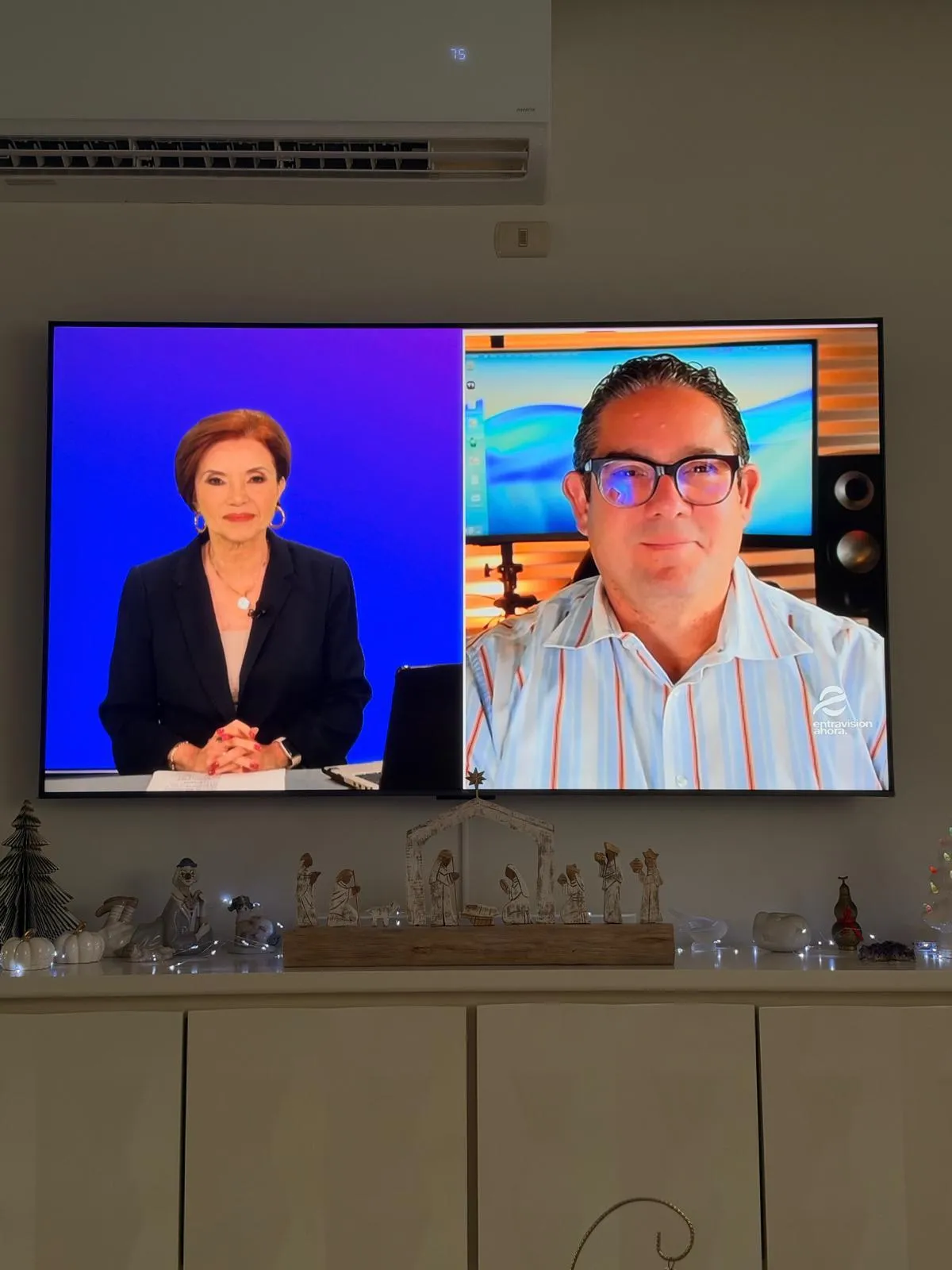
This afternoon I was on Entravision’s En Foco with Lourdes Del Río, talking through a rough week of outages — banks, Microsoft, flights — and the question a lot of people were asking: what lets anyone say, with confidence, that this was not a cyberattack?
My answer was not a yes. I did not call the week’s outages a nationwide attack. I said there was not enough information to rule one out.
“en este momento no creo que haya suficiente informacio para descartalo”
“at this moment I don’t think there’s enough information to rule it out.”[1]
I also said that when a serious vulnerability shows up, the systems often cannot be patched in a matter of hours, while attackers using artificial intelligence may be able to exploit them in minutes:
“estos sistemas no se pueden reparar en en horas pero estos estas malechos esto delizan la intelligencia artificial lo puedan explotar directamente va a en minutos”
“these systems can’t be repaired in hours, but these malicious actors who use artificial intelligence can exploit them directly in minutes.”[1]
And I said there are now autonomous AI systems that could be attacking in ways we cannot yet identify:
“hay sistemas autonomos inteligencia artificial que podi estar atacando de maneras que no podemos en este momento identificar”
“there are autonomous artificial intelligence systems that could be attacking in ways we cannot at this moment identify.”[1]
Those quotes are taken verbatim from the interview transcript, speech-recognition errors and all. I am not going to tidy them up and pretend I said something cleaner on the air.
What the FBI actually released
The same day, an FBI Dallas post about a bureau FLASH on an AI-powered hacking framework called ARTEX was widely shared, and in some commentary it was treated as confirmation that this week’s outages were a cyberattack.[2][3]
That is not what the FBI said.
The FLASH itself, FLASH-20261113-001, is dated November 13, 2026 — four days before the En Foco interview, and the same day as the FAA ground stop. The FBI Cyber Branch posted it that Friday afternoon. What circulated on Tuesday morning, about two and a half hours before I went on En Foco, was an FBI Dallas post pointing back to that earlier advisory, not a new finding about this week’s outages.[4][2]
The FLASH describes ARTEX as an open-source, large-language-model-driven platform that threat actors have used, since at least August 2026, to automate cyber intrusions “at machine speed,” from reconnaissance through data exfiltration. “ARTEX significantly reduces the time required to chain attack techniques, with some intrusions progressing from initial targeting to privileged access in under three hours.” The bureau says the framework lets people with little technical expertise run complex, multi-target operations at once.[4]
Two campaigns it names are worth being precise about. Financially motivated attacks on South Korean financial institutions led to the exfiltration of personal information from approximately 67,000 people. A supply-chain compromise of ConnectWise Cloud Backup “resulted in attempted sign-ins to more than 2,250 downstream tenants.” The FBI Dallas post adds that this October campaign “exposed Microsoft 365 customer environments.” That is a real, documented intrusion campaign. It is not a description of last week’s Microsoft 365 outage.[4][2]
The FLASH does not mention the FAA ground stop, the Chase outage, the November Microsoft 365 disruption, the NSA’s internal network, Apple, or the other service problems of the past several days. Reporting on the Tuesday circulation of the alert noted that the FBI “did not directly link ARTEX to the current outages.”[4][3]
A separate FBI post that Tuesday morning is also easy to overread. The FBI Cyber Branch wrote that its teams were “providing technical assistance” to the Department of Transportation, the FAA, and L3Harris after Friday’s air-traffic communications outage, and that “the FBI has not taken possession of any equipment.” That is an offer of help with an investigation. It is not a confirmation of a cyberattack.[5]
What has actually been said about this week’s incidents
The public record on the outages is still a set of separate explanations, not a single confirmed attack.
The FAA has said that, based on available evidence, it has “no indication that this was a cyberattack or an outside nefarious actor.” Its account is that legacy equipment became unstable when data flooded the FAA’s telecommunications network — about 1,000 connection attempts every four to five seconds — and that the initial investigation pointed to a radar site in Amarillo, Texas, and a radio communications site in El Dorado, Arkansas, where the network contractor, L3Harris, had been deploying a new router. The FAA and L3Harris are still investigating the root cause.[6]
On Monday evening, Homeland Security Secretary Markwayne Mullin told Hannity he could say “with 98% certainty we’re not seeing the cyberattack,” and that the recent disruptions appeared “individually unrelated.”[7]
Apple, after a Tuesday disruption that included iCloud account and sign-in problems, told Bloomberg and NBC News that an “internal update” caused the outages. MacRumors, reporting Apple’s statement to Bloomberg, said the company also stated that the outages were not caused by a cyberattack.[8][9]
The National Security Agency said it had experienced “temporary degradation during scheduled routine maintenance,” that some internal systems were affected, and that “mission-critical capabilities remain fully operational.” People familiar with the matter told the Wall Street Journal that the problem stemmed from a software update to patch the system and would be temporary. Officials and people familiar with the situation have said there is no indication it was a cyberattack.[10]
None of that closes the book, which is the point I was making on En Foco. It also does not add up to the FBI confirming that this week’s outages were an attack.
A real cyberattack did happen this week — a different one
What was a confirmed cyber incident, and should not be flattened into the outage story, is a supply-chain attack on Optimizely’s Web Experimentation platform, found by Scott Helme and the team at Report URI.
On November 16, malicious JavaScript was served to visitors of 178 organizations through Optimizely snippets, including sites such as Zoom, CNN, the BBC, HSBC, Equifax, Salesforce, IKEA and Peacock. Report URI examined 1,611 snippets and found 188 infected. The malware could swap cryptocurrency wallet addresses, skim payment-card details, steal cookies and screenshots, and, on iPhones and iPads, deliver iOS exploit kits. The affected sites were not taken offline; they served malware to visitors through a third-party script they already trusted. Optimizely said an unauthorized party exploited a vulnerability, and that it had fixed the vulnerability and removed the injected code. Report URI later observed that the infected files it was monitoring were clean by 23:11 UTC on November 16.[11]
That attack is serious. It is also a different fact pattern from a bank app that will not open, a ground stop, or an iCloud sign-in failure.
Where this lands
I went on En Foco to say that I would not rule a cyberattack out before there is a real investigation, that AI has changed how quickly a weakness can be exploited, and that autonomous systems may already be attacking in ways we are not yet in a position to see. The FBI’s ARTEX FLASH is evidence that this class of tooling is already in the wild, and that it can move from first targeting to privileged access in under three hours. A separate, confirmed supply-chain attack hit 178 organizations the same week.
None of those facts is the same as the FBI confirming that the outages of the past several days were a cyberattack. The bureau has not made that link. I have not made that claim either. “Not enough information to rule it out” is still the honest sentence.
References
- Otter.ai transcript of the Entravision Zoom interview on En Foco with Lourdes Del Río, November 17, 2026, 12:30 p.m. ET. Spanish quotes are taken verbatim from that transcript, which has speech-recognition errors; only the clearest stretches of the relevant answers are quoted, typographical errors included. English translations are mine.
- FBI Dallas (@FBIDallas). Post of November 17, 2026, 10:01 a.m. ET, circulating the ARTEX FLASH and noting its use in the October ConnectWise supply-chain compromise, including "attempted authentication against more than 2,250 downstream tenants." https://x.com/FBIDallas/status/2122706613014323682.
- Whedon, Ben (November 17, 2026). "FBI warns 'state-aligned hackers' using AI for massive cyberattacks." Just the News. The article notes that the warning came amid widespread outages "though the FBI did not directly link ARTEX to the current outages." https://justthenews.com/government/security/fbi-warns-state-aligned-hackers-using-ai-massive-cyberattacks.
- Federal Bureau of Investigation (November 13, 2026). "Threat Overview of ARTEX Autonomous Penetration Testing Framework," FLASH-20261113-001. https://www.ic3.gov/CSA/2026/261113.pdf. The FBI Cyber Branch posted the FLASH the same day at 2:00 p.m. ET: https://x.com/FBICyberBranch/status/2121317398305186287.
- FBI Cyber Branch (@FBICyberBranch). Post of November 17, 2026, 7:52 a.m. ET: "FBI Cyber teams are working with the Department of Transportation, the FAA, and L3Harris, providing technical assistance following Friday's air traffic communications outage. The FBI has not taken possession of any equipment. Please follow DOT and FAA for the latest updates." https://x.com/FBICyberBranch/status/2122674318039564514.
- Federal Aviation Administration (November 15, 2026). "Nationwide Ground Stop: Questions and Answers." https://www.faa.gov/newsroom/nationwide-ground-stop-questions-and-answers.
- Moriarty, Nora (November 16, 2026). "DHS chief tells Americans to 'breathe' amid tech outages, insists homeland is 'secure.'" Fox News. Mullin, appearing on Hannity, said: "I can tell you with 98% certainty we're not seeing the cyberattack." https://www.foxnews.com/media/dhs-chief-tells-americans-breathe-amid-tech-outages-insists-homeland-secure.
- Clover, Juli (November 17, 2026). "Apple Blames Internal Update for Outage, Says It Wasn't a Cyberattack." MacRumors, reporting Apple's statement to Bloomberg that the outages were due to an unspecified "internal update" and were not caused by a cyberattack. https://www.macrumors.com/2026/11/17/apple-outage-internal-update/.
- Wile, Rob, and Madison Lambert (November 17, 2026). "Apple reports outages after an internal update, says it is working to get systems back online." NBC News. An Apple spokesperson said: "Many of our systems are back up and running after an internal update caused some outages this morning." https://www.nbcnews.com/business/corporations/apple-outages-working-get-systems-back-online-rcna609861.
- Gedeon, Joseph (November 17, 2026). "National Security Agency network for internal communications goes down." The Guardian, quoting the NSA's statement on "temporary degradation during scheduled routine maintenance," and reporting that a person familiar with the situation told the Wall Street Journal the problem stemmed from a software update to patch the system. CNN and the Times, cited there, said there was no sign so far that the outage was a cyberattack. https://www.theguardian.com/us-news/2026/nov/17/nsa-national-security-classified-communications-network-down.
- Helme, Scott (November 16, 2026; updated November 17, 2026). "World's Largest Brands Infected With Malware Via Optimizely." Report URI. 188 infected snippets at 178 organizations; malware capabilities and cleanup timeline as described in the article. https://blog.report-uri.com/worlds-largest-brands-infected-with-malware-via-optimizely/.